Showing posts with label Beth. Show all posts

Friday, 5 September 2014

Representation of Class and Age in 'About a Girl'

Camera Work
Mise-en-Scene
Sound
The films main character seen as a
silhouette against the bright sky
behind her.
Editing
Representation

The spectator is first introduced to the films main character through a low angle long shot of her standing in a field against a brightly lit background. The blue and white colours of the sky behind her cause her to become a silhouette in the frame, and she can be seen singing and performing a dance routine to the song 'I'm not that innocent.' The setting then cuts to a walkway alongside a canal where derelict and boarded up houses can be seen at the edge of the water. This suggests very little wealth in the area that our protagonist lives when partnered with the dull greys and browns of the buildings. She begins talking, and a harsh Manchester accent can be heard. The spectator is unable to assume her class and status simply from the way that she talks, but the harshness of her accent, the fact that she doesn't pronounce her 'T's' and 'Th's' and her limited vocabulary, substituting words she does not know for 'thingy' make is easier to guess that she is perhaps working class. However, she later on talks about how her father doesn't have time for her because he is 'looking for work' and how her mum lives off 'Dodgy burgers and knock off Larger' which suggests that actually her parents do not work at all, and could arguably be categorised as underclass as opposed to working.
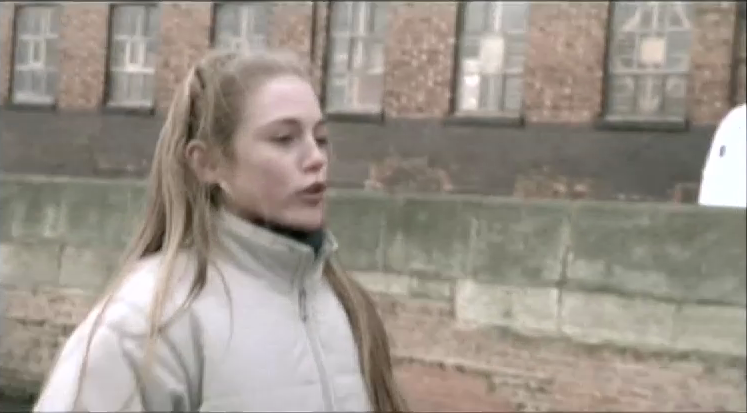
Medium shot of protagonist
walking along the canal path.

During the shots by the canal path, a handheld camera is used and mostly a low angle medium shot. This gives the impression that she is talking to someone, perhaps a friend, and the position of the camera being next to her but slightly in front results in the spectator feeling as though she is directly addressing them, and therefore feel more involved in the shot. The film mainly consists of the girl talking about various events that have happened in her life involving her friends and family. When a memory is referred to, the scene cuts and a flashback of the event follows.

The spectator is first introduced to her mum and her little sister in a memory of the three out shopping on the street. She is in the foreground of the shot, while the other two are in the background in a deeper depth of field. Her mum can be seen scratching at a scratch card, which emphasises the family's lack of money and arguably their desperation. However, the little girl can be seen jumping up and trying to get her mothers attention, which paired with the fact that the main character is separated from the two could be a representation of the relationship between the three. The mum says 'hold on a minute' to the youngest daughter when she attempts to get her attention, which suggests that she perhaps doesn't have the time for her, and possibly see's her as a nuisance. The fact that the main character has distanced herself from her mum suggests that this is something she already knows, and has come to terms with. The first reference the spectator has of her father is her mum referring to him as a 'bastard,' which reinforces the idea of the protagonists unstable home life. Disputing parents is common throughout all classes, and separated families just as much, but with both sides struggling to find work and money, the main character being part of the underclass is enhanced.


Tuesday, 22 April 2014

Beth's Evaluation

 1. In what ways does your media product use, develop or challenge forms and conventions of real media products?


Admittedly, when the first stages of our planning began none of us could typically state what exactly a thriller film was, and like many other audiences, often confused certain aspects with those of horror. But after some internet research and comparison between thriller and horror films, it became clear that the main focus in a thriller film is to build the tension and suspense, while the purpose of a horror is to elicit fear and disgust from the audience.Typically, thriller films are based on potentially real life situations, for example robberies, plane crashed and car chases, while horror is a broad genre which can range from extreme gore to simply the unexplained. We had to make sure that there were clear distinctions between the two genre's that made it clear to our audience that our film opening is a thriller.

A main influence on our thriller opening was the hit TV series Sherlock. Being a fan myself I found the specific use of contrapuntal music often used throughout the series to be really effective and causing the audience discomfort and uneasiness. The one particular episode in which we got our inspiration from see's the antagonist and Sherlock's enemy carry out a series of break ins. The music used during this scene is the Thieving Magpie. One of the things this specific track does well is reflect the chaos and mayhem of this scene, and as a group we really liked the way it broke away from and almost challenged the typical string instruments increasing in pitch and volume stereotypically used to raise tension during robberies. The Thieving Magpie effectively masks the seriousness of the events happening and turns them into something quite lighthearted and therefore more disturbing, which is why contrapuntal music was something that we really wanted to include within our opening. 

The softness within our opening could be described as almost calming, which is one of the main reasons we felt it would work really well. Unlike the Thieving Magpie where the seriousness of the events is masked by the chaos of the music, what we really wanted to do and what we felt our music choice was very effective at is amplify the seriousness of the events happening. Murder on its own is extremely horrific and terrible, so by adding such a surreal soundtrack we were able to enhance the shock of the scene, and the use of flower imagery and a range of bright colours before the murder scene to work alongside the soundtrack causing the discomfort and uneasiness we were hoping for. 

Thrillers often present the world and society as dark and corrupt, and usually contain some form of villain and an innocent victim. In our case, Graham Harvey was our villain and his eleven year old daughter was our victim. Our main way of representing and distinguishing the two was through the use of mise-en-scene. Iona was dressed in a skirt, a collared shirt and jumper, a pair of ripped tights and a large coat, as we thought that dressing her in her school uniform was the best way to show her innocence, naivety and little experience of the world. Graham Harvey was dressed in a pair of black trousers, a black jumper and black cost, the dark colours, representing his violent and aggressive personality.

Thrillers often encourage the audience to challenge their own views through their approach towards specifically tender or sensitive subjects. Bearing this in mind we chose mental health, but this was not something we could show through mise-en-scene, and so had to opt for other techniques.

Some of Graham characteristics were inspired by those of Mr Harvey from the lovely bones who too was a murderer of a young girl. After watching the scene where he rapes and kills Susie Salmon, what we really thought was effective was his ability to control, and that was something we really wanted to incorporate into our Mr Harvey. During the interrogation scene in our thriller opening, Mr Harvey appears to show no remorse or regret his actions, shown through his calm and relaxed persona and the use of medium shots and close ups, and the almost menacing smile the the wears seen multiple times throughout the scene. We really wanted Graham to be a manipulative character, and the smile worked as a really effective way of causing Susie Salmon discomfort, so we really wanted to impose the same effect into Robinson during the interrogation, and show how much control Graham can have over a person or situation through the smallest of actions.


Where any other person would have been expected to behave in a more nervous way, maybe even appearing deeply sorry for their actions, Mr Harvey's lack of any of these characteristics portray him as almost inhuman, completely detaching and separating him from the rest of the characters in our thriller opening. However, to really show the instability of his mind, we also decided to use flashbacks. Throughout the interrogation scene multiple very quick flashbacks can be seen of the night that Iona was murdered, which were not only a really effective way of confusing yet enticing the audience, but were also very successful at representing Graham's inability to distinguish his imagination from reality, having been diagnosed as a paranoid schizophrenic.

2.How does your media product represent

particular social groups?


It has been hard to determine whether or not mental health is classed as a disability, but after much research I discovered that 'a mental health condition is considered a disability if it had a long term effect on a persons day to day life,' long term being defined as 'at least 12 months' and 'day to day' meaning regularly activities such as interacting and socialising. Therefore, the two big social groups our thriller focuses on is the 'able' and the 'disabled.'

Mr Harvey is a long term paranoid schizophrenic, something that was never fully revealed to our audience but was implied and represented through various techniques. A common symptom of those who suffer with schizophrenia is appearing emotionless, a behavior which can be seen of Graham during the interrogation scene. His lack of any sort of emotion can be seen not only through medium shots and close ups, but also in the two shots containing Robinson, where a comparison can be made between Mr Harvey's calm and unresponsive persona and Robinson's tensed up and stiff stance. When asked about the events that unfolded that night, Grahams lack of response makes him seem almost inhuman, and interrupting Robinson before then telling him to 'go on' makes it seem as though he is mocking the situation.

Another symptom is hallucinations and delusions. Mr Harvey can be seen staring directly at the camera, and evidently directly at the audience. This was a really effective technique to use as it incorporated Stanislavski's idea of 'breaking the fourth wall.' He created the fourth wall as a method of making the audience feel more involved with the performance but without destroying the naturalism entirely and directly addressing the audience themselves. The hallucinations that Graham would have seen as a schizophrenic wouldn't have been seen by any of the other characters. By having him stare directly into the camera it would be like the audience were one of his hallucinations, and that he can see them but Robinson cannot. Not only do the delusions separate him from the rest of the characters, but by referring to himself and the hallucinated audience as an 'us' it is as if he is grouping them together, evidently resulting in the audience feeling more involved in the thriller, but with the indirect address through the camera acting as the fourth wall, maintaining the naturalism.

There is a strong focus on age throughout our thriller opening. Iona's age is represented through her costume; the school uniform she is wearing tells the audience that she is still young, and portrays a level of innocence about her. Being a young girl, it would have been normal for her to have a close relationship with her dad, that she should trust him and feel comfortable around him. This would then make Graham's kidnapping and murder of his daughter even more horrifying not only to Iona, but to the audience too as this was a man that the young girl put her faith in. It is also kind of sickening that an older man would wish to hurt such a naive child, and even more shocking that this child was his own. This really amplifies how unstable Mr Harvey's mind is, and could result in the audience resenting his character.


3. What kind of media institution might distribute your media product and why?

 
Our thriller film will be an independent film. This is where a film is produced mainly outside of a studio (such as Paramount and Universal) and with a much smaller budget. An example that we might use would be StudioCanal UK, a film distribution company working in the UK and Ireland, and are arguably one of the main distributors of independent British films. They also branch out simultaneously across Europe, and do a lot of work in countries such as France and Germany. Although our budget may be smaller if we make an independent film, that doesn't mean that our options are limited.

The Tyneside Cinema in Newcastle specialises in the screening of independent films from across the globe. The cinema allows budding producers and digital artists to network and present their work, and gain themselves not only publicity but revenue. By screening our film in a cinema we will be able to directly reach out to our teenage and young adult target audience and increase the success of our thriller. Unfortunately, because we are only a small independent company, we wouldn't be able to afford to advertise our film on the television for our cinematic and DVD releases, and so we may need some help when it comes to spreading the word about our film. The British film council is a charitable organisation established to help develop the British film industry and to invest in films. It runs the annual London Film Festival along with the London Lesbian and Gay Film Festival and the youth-orientated Future Film Festival. Due to their support of small independent film this could provide some opportunity for screening our film to help get it out there. However, Working Title is a company that wouldn't be interested in my film, as they tend to focus on "mid-Atlantic" Rom-coms that appeal to wider audiences in America.

Websites such as YouTube also make it a lot easier for our film to be seen. YouTube has a very wide demographic, making it even easier for our target audience to access our film, resulting in more views and more publicity, hopefully making our film more successful and evidently bringing in more revenue. Getting our film on YouTube is as simple as making an account. It doesn't cost anything so if our film isn't as successful as we would like there is no loss, and there are opportunities to make money through advertising other companies either during our film or along the side of the web page. However, in order to gain more subscribers to our channel and more views of our film, we are going to need other ways to advertise our film.

Facebook and Twitter are very effective ways of spreading the word about our film. We could not only set up a page where members of the public could follow the making of the film and track its progress, but also as an opportunity to raise the popularity of the film and evidently our independent film company. Also, like YouTube, there are opportunities to advertise around the social networking site, but because these do cost a lot of money and as we are only a small company, it may not be something within budget. However, I did set up a Twitter account for our page towards the end of the editing progress, and am still now posting to encourage people to watch our film.


4. Who would be the audience for your media product?


Due to the large amount of violence and explicit language that our thriller will include, we decided that it would be best to aim our film at both male and female 15 to 34 year olds. This would mean that when previewed at our chosen cinema, more likely Tyneside, it will need an age 15 rating on it, and that no one under that age may watch the film without being accompanied by an adult over the age of 18. We thought that this would be the most appropriate age to aim our film at because it is a demographic that not only we personally can relate to, and so will have a more accurate idea of what the audience will desire, but that will be able to relate, sympathise and empathise with the characters more. Also, due to it being a thriller, we felt that choosing a demographic any younger may result in trauma for those who watch, and if we were to aim for anyone any older they might not find it as thrilling.

Audiences who enjoyed films like Silence of the Lambs may also like our film. Although the target audience for this film was slightly higher then ours (starting at eighteen,) the similar plot lines of solving a murder and seeking out possible suspects means that both films will appeal to both audiences.

5. How did you attract/address your audience?


To attract our target audience, we chose to focus on a subject that is not always talked about but growing more and more common - mental health - in the hope that it might educate our audience. With more more younger teenagers developing conditions such as depression, bipolar and even schizophrenia, the subject is often avoided because of its sensitivity. But by making it one if the main focuses of our film it meant that the subject was almost impossible to avoid, in the hope that people will start to understand the seriousness of the condition, and that it can sometimes have negative side effects, it can be controlled.

We made sure that the age if our characters within the film were within our target audience, in order to make them as relatable as possible. Although we weren't able to use actors of the character exact ages, we used costume to make them appear older than they are, and different camera angles to impose power and status.

The low angle shots used to show Robinson make him appear bigger in the screen, delegating the power to him. They portray him as almost a heroic character, someone that the audience may aspire to be like. We use these multiple times throughout the opening to inform the audience that he is supposed to be the dominating character within the scene. However, although the high angled shots make Graham seem weaker, his body language and facial expression, seen through extreme close ups, appear to have some sort of effect on Robinson. Also, his control over the speed and direction of the conversion mean that regardless of the shot types used and regardless of Robinson's official position, it is Mr Harvey that has the control.

Iona's character is slightly younger than our demographic. We thought this would be effective as it would result in the audience sympathising with and pitying her. We portrayed her as younger and the weaker told through her costume and camera angle. In almost every shot of Iona she is being stood over and overpowered by Graham in some way, which shows the audience which is the more dominating character out of the two. However, it is not a power that the audience respect, more resent, meaning that despite his very serous condition the audience feel no sympathy towards him at all.

6. What have you learnt about technologies from the process of constructing this product?

Before studying media studies and doing these projects I had never really had the chance to work with camera equipment, so it was all very knew to me, but wasn't hard to get the hang of. There are many things that need to be carried out before filming can start (risk assessments, shot framing and white balance) so at first it was all very daunting, but the more we started to film the more it became more of a routine.

Final Cut Pro played a huge part in our film as that was where all of the editing was done. After having some practice with our preliminary task, I was really keen to do some more editing as it was something that I really enjoyed. Although there are so many tools available on Final Cut Pro it can get very daunting at times, but with practice it is very easy to get the hand of, and having Sophie and Oli around all of the time to answer any question that we might have was very reassuring.

I focused a lot more on framing our shots and depth of field when it came to filming, and the few shots I am particularly proud of are those within the title sequence. I used a shallow depth of field on trees and plants so that they were in focus, but the people in the background were not. This gave the impression of being watched, and creating a sense of voyeurism for the audience. The preliminary task was in essence a practice, and so our framing of shots wasn't as good as it could have been, therefore we knew that it was something we really had to work on this time round. Particularly during the interrogation scene, it was very important for us to make sure we captured the facial expressions of the characters as clearly as possible. Shots like the extreme close up of Graham's face side on and the medium low angle of Robinson worked really well as the facial expression were easy for the audience to read Mr Harvey's calm persona and Robinson's discomfort.

Blogger was something that I has never used before, and after using it for both our projects I now find it really easy and simple to use. One of the features I found most useful is the option to create a draft and add to it instead of just publishing the post straight away, which gave us the chance to work on it for longer and add as much as we could before uploading the finished piece. Being able to add labels to each post also helped with organisation so that we could see exactly who had posted what and when. What's also really good about Blogger is that there is an app for it in the Apple store, which meant that when I was unable to get to a computer I could still post and keep the blog updated through my iPhone or iPad.

7. Looking back at your preliminary task, what do you feel you have learned in the progression from it to the full product?

In the progression from the preliminary task to the full project, I feel as a group we definitely learned the importance of research, and just how much we were going to need to do. Overall we had three failed locations; we carried out multiple phone calls for each one in the hope that we may get permission, only to have it refused. Some taking weeks to get back to us, some not replying at all. In the end we did get permission to film at Haywards Heath Police Station, but the location wasn't quite what we were expecting and didn't really work for our film, so in the end we made the decision to film the interrogation scene in the black out pod as we were running out of time. For our prelimiary task we didn't make any sort of story, script or character profiles for our thriller, so were really keen to do those things this time around so that we were as prepared as possible.

My editing skills have definitely improved over the course of the two projects, and I feel my continuity was a lot smoother throughout shots.


As a first attempt I feel that my continuity editing was quite good, and feel that my transitions between shots were smooth and barely noticeable. We took great care during filming to make sure that each hand movement was the same, and that we filmed each shot at least three times so that we could then choose the most accurate to be part of our film, which made it much easier when it came to the editing. However, some of our earlier match on actions were not as smooth, and so we knew that that was something we would have to take more care on  in the final task.


Getting the continuity right on a shot is very time consuming, but we knew that that was what it was going to take to make our shots as smooth as possible. I am pleased with how the shots flow, and am glad that we had the opportunity of a preliminary task to practice.


Monday, 24 March 2014

Deadline Troubles

The footage that we shot a week and a half back didn't come out on the camera as we had hoped, and so I have used the time since trying to change the saturation and colours so that they are a lot clearer.

However, although it worked well on some shots, others were just too dark to change and improve, so as a result we are going to have to re-film the last scene of our Thriller.

We understand that this means we will not have met our deadline, and so we will lose marks on our time management. However, we would rather this be the case than stick to the shots that aren't going to work for us and miss out on the grade that we know we are capable of getting.

Beth

Monday, 10 March 2014

Police Interview Film Script and Shot List

1) Long shot - Harvey sat side on to the camera. Back straight, hands in lad, feet facing forwards. Blank facial expression, giving nothing away.

2) Low angle medium close up of Harvey, facing the camera. Robinson seen walking into the shot from the left, circling Harvey.

3) Medium close up two shot. Robinson continues to walk around. CONTINUITY. Robinson's arms are crossed, right arm reaching up to his mouth biting at his thumb. 

4) Long two shot. Robinson stops opposite Harvey, looking him square in the face.

5) Low angle close up of Robinson. Removes his thumb from his mouth.

6) Over the shoulder shot of Harvey. Not looking Robinson in the eyes, staring 'through' him. 

7) Low angle close up of Robinson. Still looking at Harvey.

8) Low angle close up of Harvey. Eyes snap up to meet Robinson's. 'Cheshire smile' spreads across his face - revealing only ONE row of teeth.

8) Long two shot. Both frozen in their positions.

9) Medium shot of Robinson. Taking three, slow steps forward. Begins to lean forward on the chair.

10) Long two shot. Lean forwards onto the chair in front. "Mr Harvey..." PAUSE FOR A RESPONSE. EXHALE AND HANG HEAD.

11) Medium shot. "Why don't you tell me..."

12) Close up of Harvey, side on. "Don't you mean, us?"

13) Medium shot of Harvey, side on. Harvey turns his body towards the door.

14) Medium long shot of an Officer standing outside the room. Guarding the door, standing with legs apart and arms crossed.

15) Medium shot of Harvey, side on. Lets out a small puff of air through his nose, grins. Turns back round to face Robinson.

16) Close up of Harvey. Looking straight into Robinson's eyes.

17) Extreme close up. ECU on Harveys mouth, side on. "Go on."

18) Medium shot, slightly low angled of Robinson. Straightening up, almost moving back slightly away from Harvey. Clears throat, and loosens tie. "Why don't you tell... Describe in your own words what happened that night.

Beth

Thursday, 6 March 2014

Location Update

We have decided to change our plot ever so slightly.

We will still keep the interrogation scene, but instead of then cutting to the murder itself, we are going to put small snippets as quick cut flashbacks throughout the interrogation.

We have also found a suitable location for this; there is a large forest near my house leading up to a an old victorian building now a museum. Now we have changed our plot slightly, we will not need to film anything inside, and as the park and museum are both public will not need permission to film outside.


Beth

Film Plot Update

(Long shot of Mr Harvey sat side on to the camera)There he sat, back straight and hands folded into his lap, a figure of grey and black drowned in a room full of white. His face showed no signs of panic, worry or remorse, he remained a blank canvas, and kept his gaze firmly on wall opposite. (Low angle medium close up of Mr Harvey, side on to the camera, Robinson seen walking in to the shot and walking out, clockwise) QUICK FLASHBACK TO MR HARVEYS FACE AT THE TIME OF THE EVENT (SAME SHOT TYPE) (0.5 SECONDS) Slowly and calmly, Detective Robinson circled him, keeping his eyes fixed on Mr Harvey at all times. (Medium close up pan following Robinson as he moves)His arms were crossed with his right arm reaching up to his mouth where he gnawed at the dead skin on the side of his thumb.

(Long shot of the two) After three complete circles around the suspect, Robinson stopped directly in front of Mr Harvey, looked him square in the face and (Low angle close up to Robinson) removed his thumb from his mouth. (Over the shoulder shot of Mr Harvey) The suspects eyes maintained their lack of emotion, and although their view of the wall opposite was now blocked by the tall, broad body of the detective, FLASHBACK TO HARVEY STANDING IN FRONT OF IONA (Back to low angle close up on Robinson) they did not move, and continued to look straight through Robinson like he wasn't even there. (Back to over the shoulder shot of Harvey) But after a moments more silence, they snapped up to meet the eyes of the opposition, (Low angle close up of Harvey) before a cheshire grin slowly crept its way across Mr Harvey's face, until he was beaming from ear to ear, showing only his top row of teeth. VERY QUICK FLASHBACK TO HARVEY DRAGGING IONA THROUGH A FOREST (0.5 SECONDS) BACK TO SHOT OF HARVEY

(Long shot)Feeling increasingly uncomfortable and uneasy, (Cut to medium shot) Robinson took three steps forward in an attempt to maintain control of the situation, (Cut back to long shot) and leant forward placing both hands on the chair that sat opposite Mr Harvey, QUICK FLASHBACK OF HARVEY PLACING BOTH HANDS AROUND IONAS NECK (Over the shoulder shot of Harvey) who's smile didn't alter, only his gaze which followed the eyes of the detective as they edged closer.

(Close up of Robinson's face) Inhaling and exhaling deeply before hand, Detective Robinson finally spoke.

"Mr Harvey," he paused for a response but got nothing. "Why don't you tell me..."

(Cut to close up of Robinson face on, slightly high angled for eye line match, of Mr Harvey) "Don't you mean, us?" the suspect interrupted, (Cut to medium shot of Harvey side on) shifting his gaze from the detective that sat opposite to the mirror on the wall to the right of him and raising one eyebrow. (View from the other side of the window) He stared right through, right through to the other investigators that stood on the other side, watching his every move. (Cut back to medium shot side on) He let out a short puff of air through his nose, a small gesture of laughter intended to make a mockery of those who thought they had him all figured out.

(Close up of Harvey) He averted his gaze back to Robinson who's eyes had widened in almost panic.

(Extreme close up of his mouth) "Go on," Harvey encouraged.

(Medium shot, low angled for eye line match) Straightening up and almost leaning back away from the suspect, Robinson cleared his throat, loosened his tie and carried on.

(Over the shoulder shot of Harvey waiting for Robinson to speak)

(Long shot of two) "Why don't you tell... Describe in your own words, what happened that night."

FLASHBACK OF THE WHOLE SEQUENCE IN ORDER

HARVEY DRAGGING IONA THROUGH THE MUD
HER TRYING TO ESCAPE BUT HIM HOLDING HER DOWN
HIS HANDS AROUND HER NECK WHILE SHE STRUGGLES
CLOSE UP OF HER FACE AS THE LIFE LEAVES HER EYES
HIM DRAGGING HER BODY THROUGH THE MUD AGAIN UNTIL HE GETS TO A HOUSE

LAST SHOT A PAN UPWARDS OF THE LARGE HOUSE WITH HARVEY STANDING IN FRONT

Beth

Location Problem extension

After having no luck with filming at Linden House or Marlet Lodge, Becky and I were able to find another location that we hoped would fit our thriller opening and also not be as dangerous to film in.

The location was extremely difficult to locate, and with confusing directions given to us from a friend took us well over an hour when it should have only taken around twenty minutes. We did eventually locate the premises, although it wasn't exactly what we were expecting.

The premises was a mushroom factory no longer in use, and with many empty rooms inside then would have made a really good location for the scenes involving Mr Harvey and the police raid. We were aware that a fence would have to be climbed in order to gain entry to the factory, but when we actually saw it we realised that although it would be easy enough for us and our actors to climb during the day, the shots we needed would need to be filmed at dusk and so the jump down the other side of the fence would have been extremely dangerous if we couldn't see all the way down.

After having no luck at the now three locations we were hoping to use, Becky, Megan and I may have to rethink certain aspects of our story. We had originally planned to be quite ambitious and chose quite a complex story line, but with the deadline quickly approaching we might have to change our idea completely.

We were however. given permission by Haywards Heath Police Station to borrow some of their posters in order to make our interrogation scene of Mr Harvey more authentic, meaning that we can keep some aspects of our story line the same.

Beth

Thursday, 27 February 2014

Primary School Permission


Part of our film takes place in a Primary School, so I made contact with my previous Primary School asked them if we could have permission to use their reception area to film.

Waiting for confirmation

Beth

Tuesday, 25 February 2014

Location

Outside View
Outside View


Front View


Inside


Inside

Inside
Inside
Inside


We tried multiple times to get a hold of the owner of our first location idea, Linden House, however we kept getting passed round to different companies and now we are in our filming stage and need to sort out our location.

However, as we're running out of time I started to explore other possibilities to locations that would fit the setting as a psychiatric ward/hospital where Graham Harvey is found, in the same room he was assigned to 7 years before. I came across this building just down the road from me that is an old sanitarium where patients were kept that had tuberculosis a couple of years ago. 

This building is easy to access and doesn't require permission to be entered as long as nothing is disturbed or taken from the building while we are there.

The building is very secure, however health and safety risk assessments will need to be carried out due to their being a lot of rubbish scattered on the floor downstairs, and there is a lot of broken glass around.

Becky and Beth drove to the location on Thursday the 26th of February, and the entire group will return on Friday the 27th. The location fits in perfectly with our plot and so we would really love to be able to film there.

Megan and Beth

Friday, 14 February 2014

Story

Story

Graham Harvey was diagnosed as a paranoid schizophrenic at the age of seventeen. After trying counselling and various medications, Grahams condition continued to further decrease rapidly, which resulted in him being placed into a mental asylum, Linden House. After spending four years confide to a cell with minimal contact with the outside world, Graham was eventually released. Struggling to come to terms with the world outside of the building, further counselling sessions and support meetings were set up in order to help him find his feet, and he was placed on medication to help control the paranoia he was constantly feeling.

After managing to secure a job as a warehouse assistant for a local retailer, Graham's confidence increased and he soon found himself many close and supportive friends, one of which being Sophia. After pining over her for almost six months, Graham finally found the courage to tell her how he felt, and to his luck and surprise, his feelings were reciprocated. A year on, the couple married and at the age of 24 Sophia gave birth to a beautiful baby girl, Iona, where they then relocated from Haywards Heath to the town of Crawley.

Satisfied that he had managed to turn his life around, at the age of thirty two Graham, with the support of his family, stopped all counselling sessions and took himself off of his medication. However, after just four months he found himself reverting back to his old ways, and his actions began to worry Sophia. Convinced the voices inside his head had returned, Graham became violent towards his wife and daughter, claiming that he was following the instructions of the Devil. Fearing for her daughters safety, the pair separated nine months later, and Sophia left with Iona to live with her mother. After a lengthy and stressful two year divorce process and custody battle, at the age of thirty five, Graham was denied all contact with his now eleven year old daughter.

Devastated and unable to convince the judge that he was fit to be around his daughter, Graham devised a plan to kidnap Iona. Breaking conditions of the divorce and all restrictions placed upon him, he waited outside Iona's primary school, claimed he was Sophia's brother and had come to take her home, before leading her towards his car and driving her to his house. There he tried reasoning with Iona, attempting to convince her that everything she had been told about him had been a lie. But when she tried to leave he grew angry and frustrated. As she desperately tried to make for the door he grabbed her by the hair and pulled her to the ground where she then hit her head and was knocked unconscious. Horrified by the way he had behaved, Graham began to panic, and the voices that he had tried so desperately to control returned, and before he knew it he was carrying his unconscious daughter to the only place he knew he would be safe.

***

Running late due to a meeting she was unable to leave work, Sophia called Iona's primary school to inform them she will be picking her daughter up slightly later than usual, but was told that her brother had already collected Iona. Confused, she rang her brother, only to find that he had been up North for the last two days because of work, and wasn't due home until the following day. Extremely panicked by this point, Sophia then alerted the police where an immediate search party was organised. However, the police already had their prime suspect.

Aware of what Graham was capable of, they rung up the warehouse he worked in, only to find that he hadn't turned up for work that day. With alarm bells now ringing frantically, the search was on to find Graham Harvey.

After two days of searching the police found nothing, and with the case being now high profile, they became desperate for any information. After thoroughly searching all over Crawley and the surrounding area, the police, as one last desperate attempt, asked Sophia if there was anywhere she could think of that he might possibly be, anywhere that had any specific importance to him or anywhere that he he had briefly mentioned before. And then it hit her. Linden House. With this one last vital piece of information, the team jumped straight into action and drove fifteen miles to the now abandoned building that was once Grahams home. And sure enough, there he was. In his cell, Graham waited, sat bolt up right, with his legs cross and hands in his lap, grinning from ear to ear.

Back at the police station he told them how he had done it. He willingly and, perhaps, eagerly told them how he had cussed at her, beaten her, felt her pulse slow rapidly as his hands tightened around her neck. How he had seen the fear on her face, and laughed. How he had watched the life disappear from her eyes, and felt satisfied. But he never told them what he had done with the body.

Beth

Thursday, 13 February 2014

Police Permission


This is a video of Beth getting permission off of Sussex Police to use on of Crawley Police Stations interview rooms as one of our sets for our thriller. Unfortunately we weren't able to speak to them directly, but all relevant details have been passed on, and they should be in touch shortly.

We realise that it would have been easy for us to upload all of the footage, but because I spent a lot of time on hold it gave us an opportunity to practice our editing some more, and its something we had fun doing.

Beth

Depth of Field


Depth of Field is simply the distance between the nearest and farthest objects within the shot that appear sharp.

The shorter the focal length the larger the depth of field.
The longer the focal length the smaller the depth of field.


Depth of Field is highly effected by the distance of the subject from the lens. For example, the closer the object to the lens, the shallower the depth of field. And alternatively, the further away the object, the deeper the field. Moving closer or further away to the subject is the least effective way to improve image quality as is changes the composition of the shot. By using depth of field, its easier to maintain the compositional integrity, and still be able to alter the distance between lens and object.

One major aspect of DOF is the 'thirds'. The window of focus does not occur evenly in front of, and behind, your focal point. Approximately 1/3 of the DOF window will occur in front of your focal point and 2/3 will occur behind your focal point. This head shot of a young jaguar is an excellent example of the 1/3 in front, 2/3 in back rule. If you examine this photograph closely, you will see that the point of focus is on the bridge of the nose between the eyes. This POF, slightly forward of the eyes, kept the tip of the cat’s nose in focus. The 2/3 behind was enough to keep the left ear in focus while the right ear is already going soft. The background is completely out of focus.

Beth
istance in front of and behind a focus point that appears sharp in a photograph
Read more at http://www.amateurphotographer.co.uk/how-to/tech-explained/536453/depth-of-field-explained#gRrvZYyXkzopZUYD.99
istance in front of and behind a focus point that appears sharp in a photograph
Read more at http://www.amateurphotographer.co.uk/how-to/tech-explained/536453/depth-of-field-explained#gRrvZYyXkzopZUYD.99
istance in front of and behind a focus point that appears sharp in a photograph
Read more at http://www.amateurphotographer.co.uk/how-to/tech-explained/536453/depth-of-field-explained#gRrvZYyXkzopZUYD.99

Sunday, 2 February 2014

Three Point Lighting


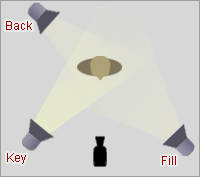
Lighting is used to add mood and drama to a shot, to help make objects appear more 3D and to highlight the outline of an object of character. Three point lighting enables the director to illuminate the subject in the shot however desired, while controlling all shading and shadows.


Key Light
The strongest out of all three, the key light has the most influence on the shot. It is placed on one side of the subject, causing one side to be illuminated and the other in darkness or in shadow. High Key Lighting produces soft edges and and no shadows, often associated with realism, while Low Key Lighting produces more shadows and areas of darkness, used to create a tense and mysterious atmosphere. Reflectors can be used to help balance out the light.


Fill Light
This is a secondary light, and is placed on the opposite side to the key light, filling in shadows and helping to make the subject to appear softer. As the role of the key is to only allow us to see a little more detail, it is not as intense as the key light, and similar reflectors can also be used in order to maintain the balance between the two.


Key, Fill and Back

Back Light
The back light is placed behind the subject and lights for the rear. Rather than providing direct light, its purpose is to provide definition and subtle highlights around the subjects outline. It also helps separate the subject from the background, resulting in them appearing more 3D.


We tried out different techniques with each of the lights, creating different shadows and areas of darkness. In this picture, we held a spotlight next to the side of Becky's face. this then put one side in full light while the other remained heavily shadowed. This then made her appear more mysterious, a technique that we would really like to use within our thriller in order raise tension.

Beth